

Fear of rejection is common during adolescence, when friendships and peer acceptance become more important. But when that fear starts keeping your teen from being themselves or living a life that’s meaningful tot hem, they may need support.
Let’s look at what fear of rejection can look like in teens, ways teens can overcome it, and how you can support your teen if they’re actually being rejected by their peers.
What does fear of rejection look like in teens?
Teens who fear rejection more intensely tend to see it everywhere. They may interpret neutral events as proof that someone is upset with them. They might expect to be left out or rejected before they know what will happen, or feel anxious about showing others who they really are.
Signs of fear of rejection in teens include:
- Worrying that friends are mad at them or don’t like them.
- Reading a delayed text or brief response as a sign of rejection.
- Avoiding social plans or activities because they don’t feel like they’re truly wanted.
- Asking for frequent reassurance that friends still like them.
- Reviewing every interaction afterward to check for signs that the person was upset with them or to make sure they said the “right” things.
- Changing how they act or what they say to gain approval.
- Feeling intensely upset after a disagreement or a small change in someone’s behavior.
- Pulling away from people first to avoid the chance of being rejected.
Some of these behaviors can also be signs of social anxiety or another concern. What matters is how often they happen and whether fear is getting in the way of your teen’s daily life.
How to overcome the fear of rejection as a teen
It’s completely normal for teens to be scared of rejection. As a teen (and even as an adult), it’s natural to want to fit in. Humans are social animals, meaning that we can’t survive without each other. So our brains read social rejection (or the possibility of social rejection) as a literal threat to our survival.
So if you’re a teen reading this, don’t judge yourself for being afraid of rejection. At the same time, sometimes that fear can get so intense that it gets in the way of living the life you actually want. When it crosses that line, it’s important to address it.
Here are some ways teens can overcome fear of rejection.
Remember that feeling rejected is not rejection
People who have a more intense fear of rejection tend to look for rejection everywhere. And when you look for something, you usually find it. But remember that feeling rejected isn’t the same thing as rejection. We may be projecting our fears onto others, and seeing rejection when it isn’t there.
For example, a friend might not answer your message for a few hours. You might feel anxious and start thinking they’re ignoring you or don’t want to be friends anymore. But just because you feel anxious doesn’t mean your fears are automatically true. They might be busy or just unsure what to say. It can help to separate “I feel rejected” from “I was rejected.”
Avoid rumination
Ruminating and analyzing social situations usually keeps you stuck in the fear, and can even make it stronger. Your brain may trick you into believing that if you just keep going over it enough times in your mind, then you’ll get more insight into whether or not you were really rejected, what you can do differently next time to avoid being rejected, etc.
But the truth is that you’ll never know with 100% certainty what other people are thinking. Your brain is trying to find a way to feel safe, but [finish]. So when you feel rejected, try to instead just let the feeling be there without trying to control it. Some situations just are what they are.
Challenge thinking spirals
Fear of rejection is often rooted in unhelpful thinking patterns or “cognitive distortions.” For example, you might be falling into personalization, which is when you take other people’s behaviors personally, even when it may not be. Or you might be falling into all-or-nothing thinking: “If they haven’t given me clear signs that they’ve accepted me 100%, then that means they’ve rejected me.”
The problem with these thinking patterns is that they’re not true, and usually unhelpful. When you notice one, pause and ask yourself what you know for sure. Then consider whether there could be another explanation. You might also ask what you’d say to a friend who was having the same thought.
Practice staying grounded
Grounding is a way to stay connected with your body in the present moment, even (especially) when you’re feeling intensely anxious or upset. This prevents you from getting lost in thinking spirals when you feel rejected. There are many ways to ground yourself. For example, you can use your five senses; try to connect to things you can see, hear, smell, touch, and taste.
Practice grounding regularly, before the actual fear of rejection comes up in your real life. You might visualize an imaginary scenario or think about a memory where you felt rejected. When you notice that feeling come up, practice a grounding technique. This teaches your nervous system that being rejected doesn’t mean you’re in danger.
Do it anyway
Overcoming fear of rejection usually doesn’t mean waiting until you’re no longer afraid. Often, it’s about doing something anyway, despite the fear. You can feel the fear of rejection and still decide not to let it hold you back.
Start with something that feels manageable. You might say hi to someone in class or share an opinion even if you’re not sure everyone will agree. The more you practice, the more confident you may feel living your life even if you might get rejected sometimes.

How to help teens deal with rejection from peers
Unfortunately, rejection is part of life. Even if your teen overcomes their fear of rejection, that doesn’t mean that they’ll never be rejected. Parents often wonder what to do when their teen isn’t just afraid of being rejected — they actually are being rejected.
Rejection can come on a spectrum, from getting rejected by a crush to being ostracized by an entire peer group. Either way, it’s painful to watch your child go through this. But your role in helping them navigate the situation can depend on what’s going on.
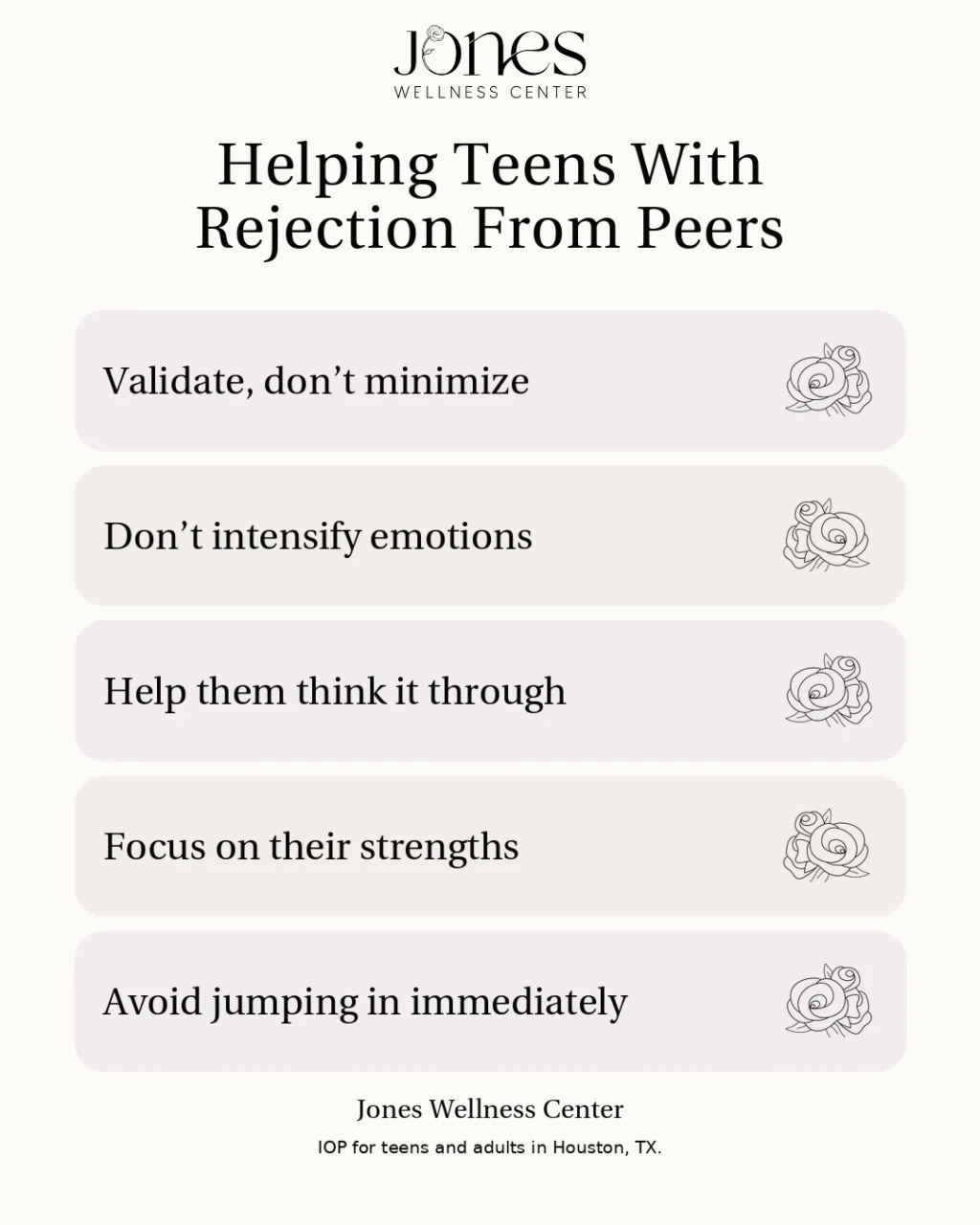
Validate, don’t minimize
As a parent, it’s natural to want to cheer your child up when they’ve been rejected. You see how wonderful your teen is, and you wish they could see it for themselves. Although it’s well-intentioned, this feeling can sometimes lead to unintentionally minimizing your teens’ experiences. You might say things like, “They’re just jealous,” or “You’ll make new friends.”
Instead, let your teen know you can see how much it hurts. You might say, “That sounds really painful,” or “I’m glad you told me.” Remember that the pain of this is very real for your teen, even if may seem minor from the outside looking in.
Don’t intensify emotions
At the same time, don’t exaggerate emotions or turn a normal teen conflict into a crisis. It’s possible to validate your teen’s emotions without being pessimistic and assuming the worst. You can also be validating without immediately attacking the other teens involved.
Avoid saying things like, “Those kids are awful,” or “This is going to ruin your senior year.” It may be necessary to take some time to manage your own emotions about the situation first.
Help them think it through
After you’ve listened to and validated your teen, ask if they want help processing what happened. You could go through the event step by step and talk through things like what actually happened vs. how it made them feel. You can try to look at the situation from different perspectives. If they seem ready, you can gently point out a possible thinking pattern without telling them what they should believe.
For example, you might say, “You mentioned that they didn’t sit with you today. Do you know why, or are you still trying to figure that out?” Give your teen space to come to their own conclusions. They may want help problem-solving, or they may just need you to listen.
Focus on their strengths
Remind your teen that even if they were truly rejected, that doesn’t determine their inherent worth. Try to focus on innate qualities they can recognize in themselves, such as being thoughtful or creative. You can also notice effort: “I saw how you kept practicing, even when that was frustrating.”
This is different from brushing off what happened or telling your teen that the other kids don’t matter. Their friendships may matter a lot to them. You’re helping them look at a fuller picture of who they are, even when they’re hurting.
Avoid jumping in immediately
When you hear about your teen being rejected by their peers, you may want to step in immediately to solve the problem. You might want to talk to other parents or report it to school administrators. But unless there is a safety issue (including emotional/psychological bullying), or your teen asked you to get involved, pause before jumping in.
Most teens don’t want their parents getting in the middle of their peer conflicts. Give your teen a chance to tell you what kind of help they want and to try handling the situation themselves, if it’s safe to do so. You can offer to brainstorm what they might say or do next. Of course, if the rejection is bullying or affecting their safety, then take action to keep your teen safe.
Teen anxiety therapy in Houston, TX
If fear of rejection is keeping your teen from school, friendships, or activities they care about, a therapist can help them understand what’s behind the fear and practice responding in new ways.
Jones Wellness Center mental health IOPs for teens and adults in Houston, TX. Unlike many other IOPs, our program is based solely on mental health concerns, not only substance use, so your teens will participate with peers who can understand them on a deeper level. We have sessions specifically designed around how to overcome the fear of rejection.
With the right support, teens can learn to face their fears and recover from painful experiences when they do inevitably happen. Contact us to learn more about teen anxiety therapy and IOP at Jones Wellness Center.