

Inner child work can be an important part of therapy and healing. The concept may not resonate with everyone, but many of us hold on to patterns from our childhood. For example, you might react to something in your adult life and wonder, Why did that affect me so much?
Inner child work can help you understand those reactions with more self-compassion. It can also help you reconnect with parts of yourself that may have been neglected, including your sense of playfulness and joy.
Here’s how you can talk to and start healing your inner child
What is inner child work in therapy?
First, what exactly do therapists mean when they talk about the “inner child”? In essence, your inner child is your vulnerable younger self. It’s the idea that we all have a metaphorical child within us, no matter how old we are. During your formative years, this child learned and observed. They internalized messages about who they were and what the world is like.
The lessons we learned, consciously or subconsciously, as children continue to stay with us as adults. If you haven’t addressed the events in your past, especially early childhood trauma, your inner child may still be holding on to hurt and anger, which can show up in your adult life and relationships.
In Internal Family Systems, we might look at the inner child as ‘Exile’ parts, which are vulnerable parts of ourselves that carry pain, fear, shame, or unmet needs from earlier experiences. Other protective parts may work to keep these Exiles from being hurt again, even when those strategies no longer serve you today.
Carl Jung viewed the child archetype as more than a memory of childhood. He saw it as a symbol of both the parts of ourselves that have been forgotten or pushed aside, as well as our capacity for growth and becoming more fully ourselves.
Your inner child can represent qualities like playfulness, joy, curiosity, and hope. In adult life, these may be qualities that you feel far removed from.
In therapy, “inner child work” is about gifting yourself corrective experiences. In many ways, it’s about reparenting yourself. As a child, you may not have received the safety, validation, affection, protection, or consistency you needed. As an adult, you can begin learning how to offer those things to yourself.

How to connect with your inner child
The first step to speaking with your inner child is to reconnect with them. So many of us are so far removed from childlike playfulness and curiosity that it can feel strange or even uncomfortable to access these parts of ourselves again. If you experienced trauma as a child, it can also feel incredibly painful to reconnect to a younger version of yourself who felt vulnerable and afraid.
All trauma work can be challenging for this very reason. Revisiting the past can bring up emotions or memories that you’ve spent years trying not to feel.
But the goal of trauma work isn’t just to dig up old memories for the sake of it. It’s to help you understand how those experiences continue to affect you today and give your brain and body the opportunity to process them differently. If you have a significant trauma history, it’s important to do this work with a trained trauma therapist who can help you stay grounded and emotionally safe.
You don’t have to start right away by thinking about the painful parts of your childhood. You can reconnect with the child within in other ways:
- Look through childhood photos and notice what feelings come up.
- Return to hobbies or activities you enjoyed when you were younger. Listen to old music or watch nostalgic TV shows.
- Give yourself opportunities to play without worrying about being productive or “good” at something.
- Notice situations where your emotional reaction feels bigger than what is happening in the present moment, and whether that could be related to a lesson you learned in childhood.
- Pay special attention to things that make you feel curious, silly, creative, or excited.
- Think about what your younger self loved, and consider how you could bring more of it into your life now.
Things your inner child needs to hear
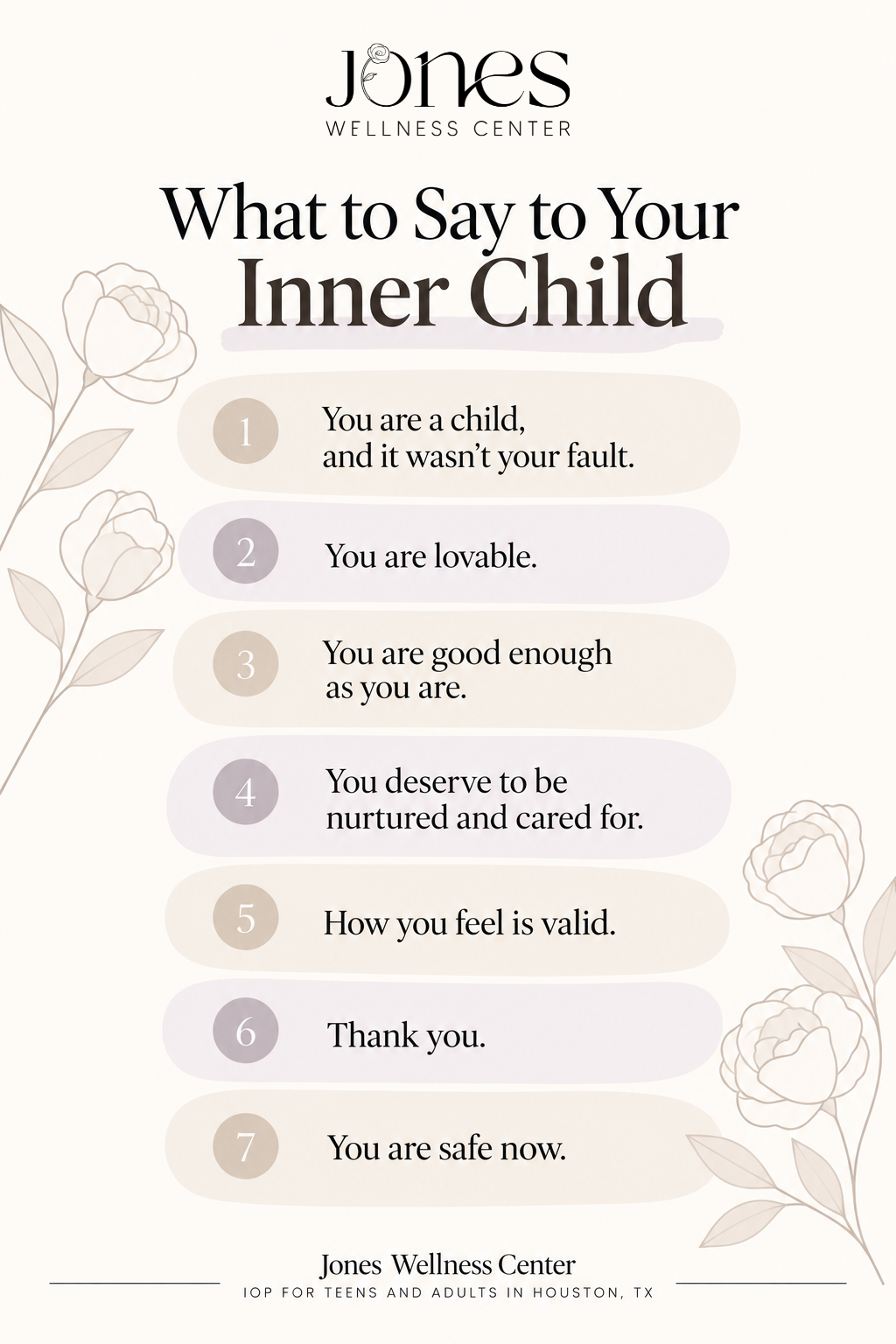
What exactly to say to your inner child depends on what they’re still carrying for you. But in general, try to nurture your child self. You may consider journaling or writing your inner child a letter if it’s easier for you to connect to your feelings in this way. Here are some things that the child part of you may need to hear.
- You are a child, and it wasn’t your fault. Children often blame themselves for the things adults do. You may need to remind your younger self that you weren’t responsible for an adult’s anger, abuse, absence, addiction, etc. It may help to think about another child today going through what you did. It may make it clearer to you that children truly hold no responsibility for their own abuse.
- You are lovable. You may not have felt loved at all as a child. If love felt conditional growing up, you may have learned that you needed to behave a certain way to deserve it. Your inner child may need to hear that love doesn’t need to be earned. Children deserve unconditional love.
- You are good enough as you are. You don’t have to be perfect, useful, quiet, successful, or easy-going in order to have inherent worth.
- You deserve to be nurtured and cared for. Your needs were never “too much” simply because the adults around you weren’t able to meet them. Children deserve nurturing, no matter what.
- How you feel is valid. You may have learned to minimize your emotions or distrust your own reactions. You can remind your child self that their fear, sadness, anger, confusion, grief, etc. were valid and made sense.
- Thank you. You can thank your younger self for surviving, for doing the best they could with the tools they had.
- You are safe now. If you are genuinely safe in your current environment, remind your inner child that the danger has passed and that your adult self can protect you now. If you aren’t currently safe, focus instead on what you can do to get out of the crisis.
What questions can I ask my inner child to help them heal?
You can also ask your inner child questions and reflect on your answers.
- How old am I feeling right now? When you’re feeling unusually vulnerable or having a strong emotional reaction, ask yourself how old you feel. You might find that you’re feeling as vulnerable as a very young child.
- What emotions are coming up for me in this situation? Try to name what you’re actually feeling without judging or immediately trying to change it.
- What do I need to feel safe? This might be what you needed then, as a child, or what you need today.
- What did I need, but not receive? Think about what was missing for you as a child, like protection, affection, attention, stability, or permission to be yourself.
- In what ways can I give that to my child self now? Consider how your adult self can begin meeting some of those needs today.
- What connects me with joy and whimsy? Think about the things that help you feel playful, curious, creative, or free.
- What about my current adult life would make my child self feel proud? Notice how far you’ve come and what you’ve created, survived, learned, or accomplished.
How a trauma therapist can help
If you experienced abuse or abandonment as a child, it likely shaped the way your brain understands closeness in relationships. You may have learned that people who love you can also hurt or abandon you. These early experiences can continue to influence how your nervous system responds to intimacy and vulnerability, even when your current relationships are safe.
Trauma therapy isn’t just about digging up old memories and talking about them. It’s a careful and methodical process that helps you build safety and coping skills before approaching painful experiences at a pace your nervous system can tolerate. Talking or thinking about traumatic memories with an untrained professional can just bring up more pain.
A trained trauma therapist can:
- Help you recognize connections between childhood experiences and current patterns.
- Teach you grounding and nervous system regulation skills before working with traumatic memories.
- Help you identify the beliefs you developed about yourself because of what happened to you.
- Support you in processing painful experiences without becoming overwhelmed.
- Help you recognize what your younger self needed and find healthy ways to meet those needs now.
- Give you opportunities to experience safe, consistent connection within the therapeutic relationship.
Join our trauma-informed mental health IOP in Houston
At Jones Wellness Center, our trauma-informed mental health IOP in Houston provides a supportive, nurturing place to understand how your past is still affecting you and learn new ways to feel safer in your body. We work with teens and adults who need more support than weekly therapy can provide.
Our office is intentionally designed to be cozy and comforting, and you’ll attend treatment with others who are going through similar hardships.
Get in touch with us to learn more about our programs.