

It can feel so helpless to watch your teen suffer, even after going to therapy once a week. Maybe it feels like their progress has stalled, or they’re having a harder and harder time managing their emotions. You’re doing everything you can to support them, but you’re starting to wonder what else you can do. You worry: will I need to hospitalize them?
An adolescent intensive outpatient program (IOP) could be what your teen needs. Even if once-a-week therapy doesn’t seem to be enough, that doesn’t necessarily mean that your teen needs to leave home for residential care. An adolescent IOP provides structured and intensive mental health support for your teen while still allowing them to live at home and continue going to school.
As teen therapists, we understand that taking the next step can be overwhelming. The fact that you’re thinking about it shows how much you want to support your child. Here, we’ve put together everything we think you should know about adolescent IOP.
What is an intensive outpatient program (IOP) for teens?
An IOP is a type of structured mental health group treatment program that allows people to get the support they need while still living at home. Clients in IOPs usually participate in the program multiple days a week for several hours per day. The foundation of most IOPs is group therapy, although many include individual therapy as well.
An adolescent IOP is simply an IOP that’s designed especially for teens. This is so important — a traditional adult IOP can’t meet the unique needs of teenagers.
You can think of IOP as lying somewhere in between traditional outpatient therapy and inpatient or residential treatment.
With outpatient therapy, your teen typically sees their therapist once a week, in their office or online. Then, they go back to their lives for the rest of the week. You may be able to schedule a second session for them on particularly challenging weeks. But generally, outpatient therapy isn’t designed to provide intensive support for severe mental health needs.
In residential or inpatient treatment, teens live at the treatment facility. Some facilities are hospital settings, and others are designed to feel more like home. They participate in treatment every day, and they’re typically supervised 24/7.
So many teens need more support than once-a-week therapy can provide. With IOP, your teen can get the structured support they need and still come home to you every day.

How adolescent IOP works
In a nutshell:
- Your teen goes to IOP multiple days per week for several hours each time.
- They participate in structured treatment activities with other teens in the program.
- They continue living at home and can keep going to school while they’re in treatment.
- Parents and other family members do not attend core IOP treatment, but they may participate in family therapy and parent coaching to learn how to support their teen.
In most programs, teens attend IOP treatment multiple days per week. The exact schedule depends on the program. For example, our adolescent IOP at Jones Wellness Center meets 3-5 days a week for 3 hours each time.
While they’re attending IOP, your teen will go through a structured treatment program for whatever mental health concerns they need support with.
Most IOPs in Houston, Texas combine substance use and mental health treatment. Ours focuses solely on mental health needs like trauma, depression, and anxiety. This allows us to create a supportive peer environment where teens are grouped with others whose treatment needs are a good fit for our program. You can rest assured that your teen won’t need to be exposed to or have to talk about behaviors that don’t affect them.
Many teen IOPs, including ours, meet after school hours. This means that teens don’t have to miss out on the important social and academic events in their lives to get the treatment they deserve.
What does a typical IOP schedule look like?
How exactly your teen spends their time at IOP depends completely on the program. What you can be sure of as a parent is that they’ll be receiving treatment designed to help them understand what they’re going through and build skills they can use outside of therapy.
Here’s what our adolescent IOP schedule looks like:
3:00 to 3:30 p.m.: Drop-off, therapeutic check-in and regulation
3:30 to 4:30 p.m.: Group therapy (Session 1)
4:30 to 4:35 p.m.: Break
4:35 to 5:30 p.m.: Group therapy (Session 2)
5:30 to 6:00 p.m.: Skills integration and coping practice
6:00 p.m.: Closing and pick-up
Several hours of treatment can sound like a lot, especially if your teen is already overwhelmed. But our adolescent IOP doesn’t expect teens to sit in a chair and talk about their feelings for hours at a time. Activities, breaks, movement, and different types of groups keep things fun and engaging.
What type of treatment is included in an IOP?
Different IOPs use different treatment methods. The therapists running the program design the curriculum and what treatments to include. Generally, teen IOPs include a combination of:
- Group therapy: Teens meet with a therapist alongside other teens who are going through their own mental health challenges. Groups give teens a chance to receive support and practice relating to other people in a safe environment.
- Psychoeducation and skills-building: Helps teens understand what’s going on in their brain, and learn new strategies to cope.
- Individual therapy: Gives your teen private time with a therapist to focus on what they’re going through. This can be especially important if something comes up during a group session that they need more space to process one-on-one.
- Family therapy: You may be asked to participate in family sessions. Family work gives teens and parents a supported space to work through challenges at home. It can also help you, as the parent, learn how to keep up the momentum between sessions.
- Medication management, when appropriate: Many teens benefit from taking medications to support their mental health, so regular psychiatry check-ins could be part of IOP. This doesn’t necessarily mean that all teens who participate in IOP will need to take medication.
How involved will I be as a parent?
Teens in IOP mostly meet with the therapists and other teen participants without parents in the room. But mental health treatment for teens works best when parents are involved.
Although you likely won’t participate in the daily activities of IOP, you could be pulled in for family counseling sessions. It’s important for you to learn how to support what your teen is working on in treatment without feeling like you have to become their therapist at home.
These sessions can also help you learn new ways to respond when your teen is overwhelmed and how to maintain supportive limits.
Who is adolescent IOP best for?
Adolescent IOP can be helpful for teens who are having a hard time in their day-to-day life because of their mental health. But it’s not the best fit for everybody.
IOP is most appropriate for teens who:
- Live with a mental health condition like depression, anxiety, OCD, or bipolar disorder
- Have experienced a traumatic event or lived through complex trauma
- Experience moderate to severe symptoms that haven’t responded to weekly therapy
- Are stable enough to live at home (this means that both they and you, their parent, feel like it’s safe to keep them at home)
- Are able and willing to commit to attending treatment for several hours per week
- Are transitioning out of inpatient or residential care
In some cases, your teen might need a higher level of care (like inpatient or residential treatment). IOP might not be the best fit for your teen if:
- They’re actively suicidal or can’t keep themselves safe at home
- Their mental health concerns cause them to become aggressive with other teens in the group
- They need medical stabilization (due to an eating disorder, substance use withdrawal, etc.) that can’t be safely managed on an outpatient basis
- They need 24/7 supervision
At Jones Wellness Center, we’ll always have an honest conversation with you if we feel that your teen needs more support than an IOP can provide. We know that this decision can feel scary for both parents and teens, and we’re here to support you through it. We work with local inpatient treatment facilities to make referrals when needed.
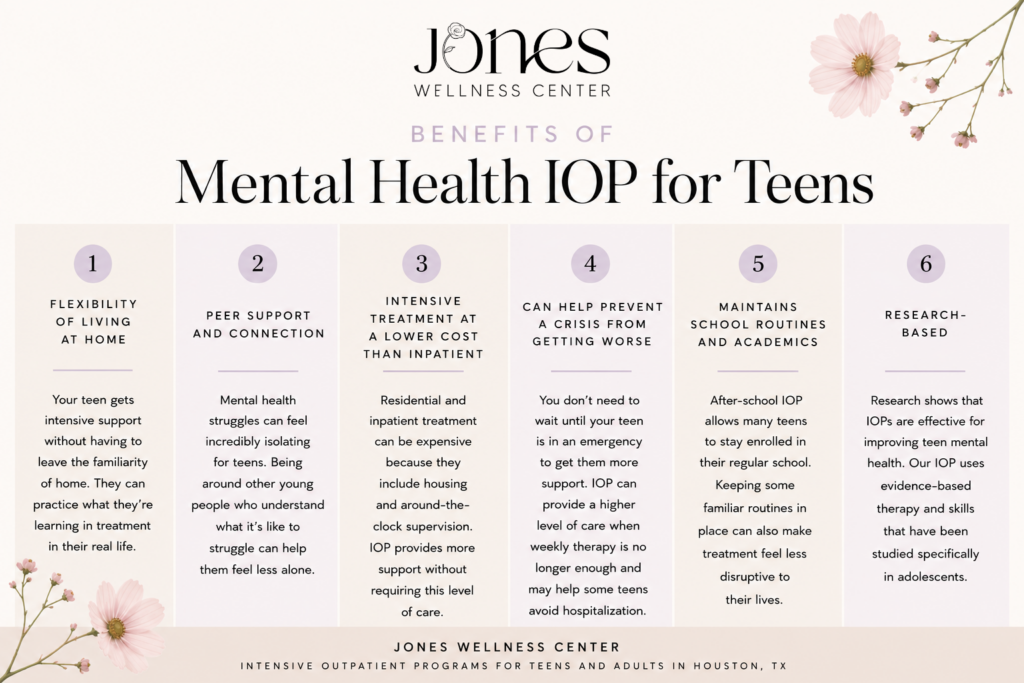
Benefits of mental health IOP for teens
IOP isn’t necessarily the “best” treatment choice for every struggling teen. But it does come with many practical and emotional benefits.
- Flexibility of living at home. This is one of the main benefits that makes IOP so attractive for so many people. Your teen gets intensive support without having to leave the familiarity and comfort of home. This also means they get to practice what they’re learning at IOP in their real lives.
- Peer support and connection. Group therapy is a big component of IOP, and adolescent IOP is designed specifically for teens. Your teen gets to be around other young people who understand what they’re going through. That feeling of connection and support can help them feel less alone and play a big role in their healing.
- Intensive treatment at a lower cost than inpatient. Speaking in terms of logistics, IOP is typically much less costly than inpatient treatment. Inpatient treatment includes 24/7 supervision as well as housing and meals. So if your teen doesn’t need that, then it may not make sense to pay for it.
- Can help prevent hospitalization and crisis. IOP can be a way to connect your teen with more support before they’re in a full-blown crisis. For many teens, the program can prevent them from getting to a point where they need hospitalization.
- Maintains school routines and academics. After-school IOP allows many teens to stay enrolled in their regular school. They don’t need to choose between treatment and other important things in their lives like friends and extracurricular activities.
- Research-based. Lastly, research shows that IOP works. It can reduce symptoms like depression, self-harm, suicidal thoughts, and more. Many IOPs use evidence-based therapies and skills that have been studied in adolescents.
Is IOP worth it?
So is IOP worth it for your teen? That’s a question only you and your teen can answer. If your teen already has a therapist, they can help you make the right decision, too.
We invite you to reflect honestly about your child’s needs. It can be painful to acknowledge that your teen may need more mental health support than their weekly therapy sessions can provide. But the earlier your teen gets the treatment they need, the greater chance they have at living the kind of life they want to live.
Have an open conversation with your teen (and their therapist) about what has and hasn’t been working. Your teen may have fears about joining a group or worry about what IOP will be like. Give them space to tell you what feels scary without immediately trying to convince them not to feel that way.
Learn More About Our Adolescent IOP in Houston, TX
At Jones Wellness Center, we know that walking into mental health treatment can feel intimidating, especially for teenagers. We’ve intentionally created a space that feels warm and cozy. Teens can settle in and take their time building trust.
Our Houston adolescent IOP combines structured mental health treatment with a gentle, trauma-informed approach. We pay attention to what teens are experiencing emotionally, and also help them understand what stress and trauma can feel like in their bodies.
Get in touch with us to talk about whether an adolescent IOP could be the right choice for your teen. We’re here to help you understand your options and feel less overwhelmed in the process.